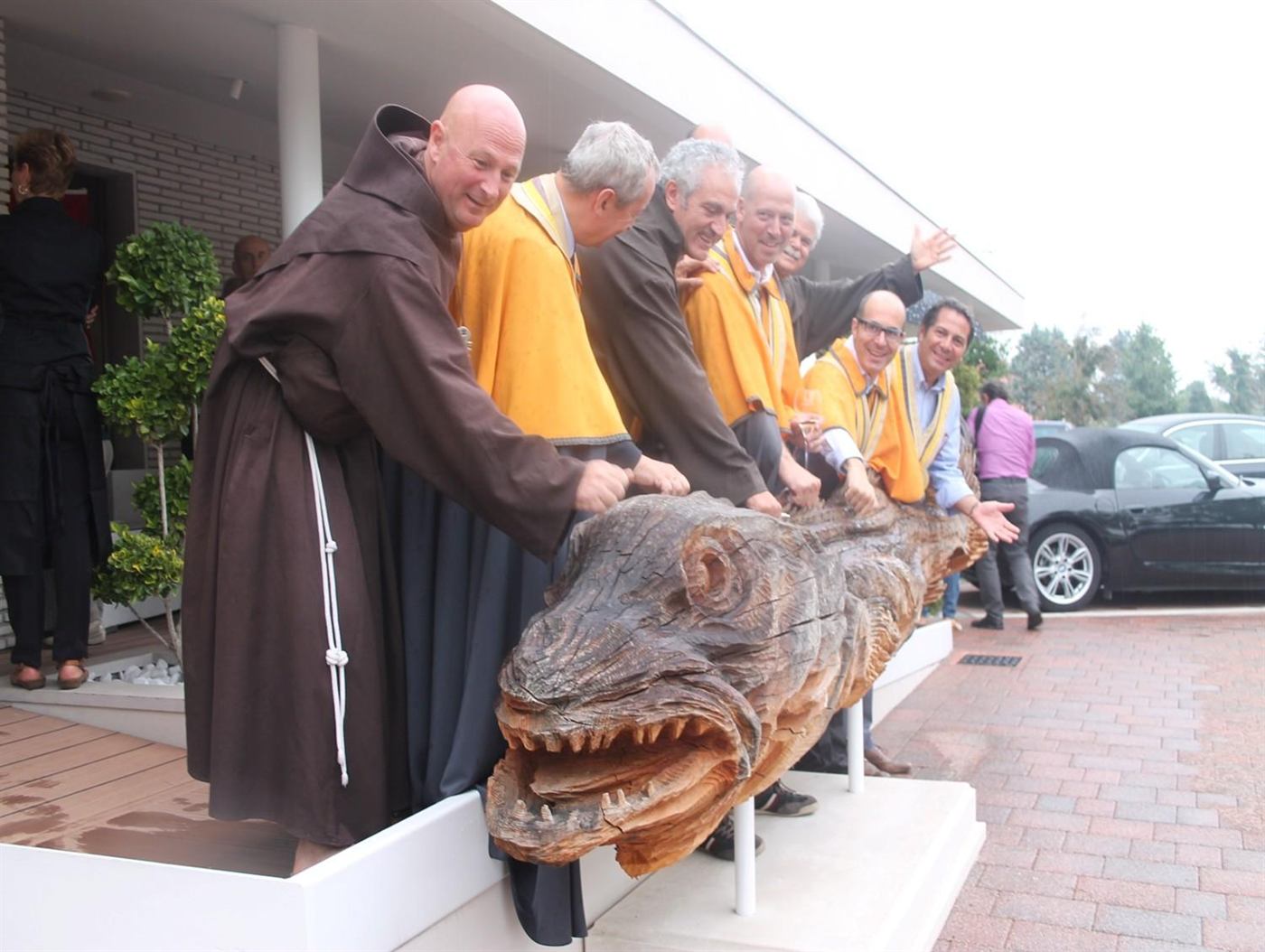
The King Cod in Bergen – beautiful in its grotesque features and a popular tourist attraction. The story of the cod king's magical power and influence lived for centuries among Norwegian and Canadian fishermen.
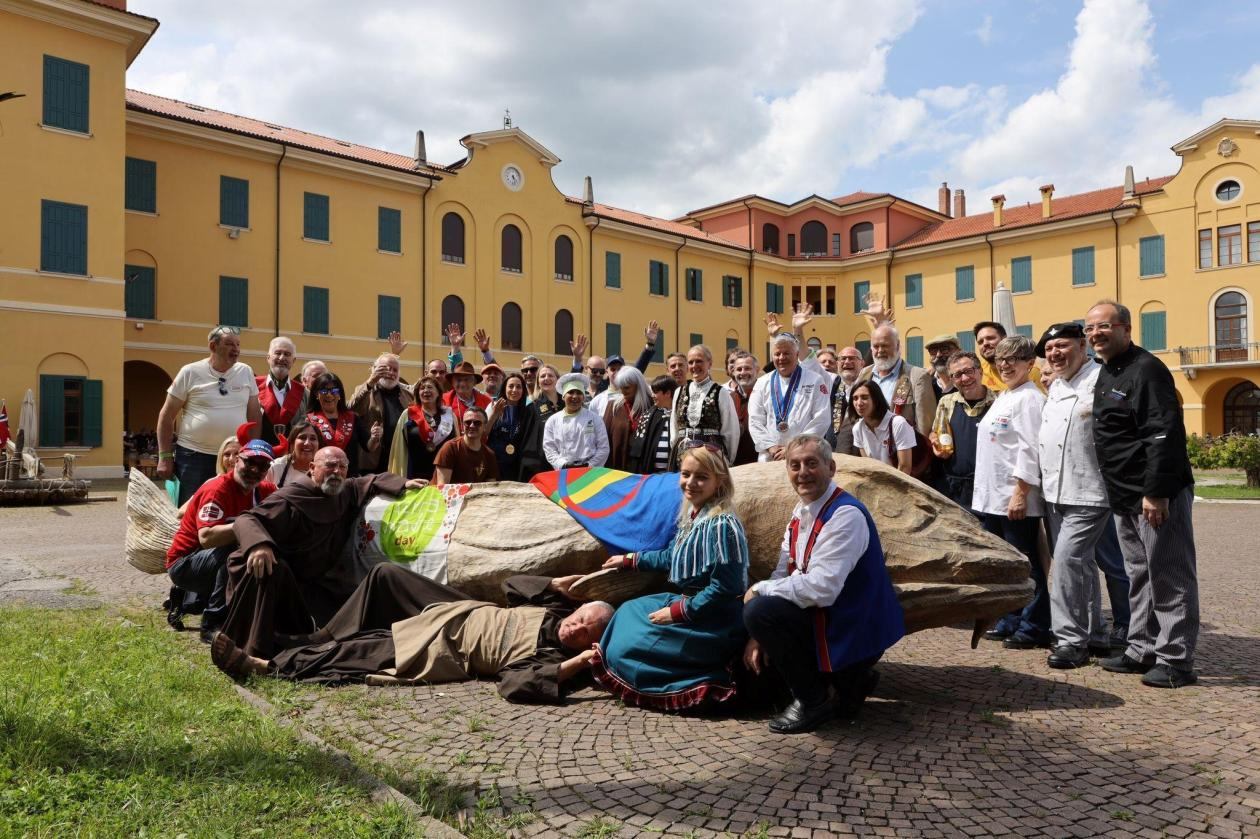
The Italian artist Alessandro Pavone created the six-metre-long wooden sculpture of the cod king shown above, which became a true tourist attraction at the historic Bryggen wharf in Bergen. In 2026 the sculpture was restored by Bergen Vel with support from the City of Bergen and moved to Nøstetorget, where it will be given a protective home under a flexible timber-frame shelter. (Photo: Terje Inderhaug)
▶ Watch the King Cod on YouTube
The existence of the Cod King was first documented in the 17th century through a colored drawing made by the county governor and scholar Hans Hansen Lilienskiold (1650–1703). Even at that time, the name "cod king" seems to have been well established among the fishermen of Northern Norway—Lilienskiold certainly knew it. The myths surrounding this strange fish lived on for centuries as an unshakable truth among both Norwegian and Canadian fishermen.
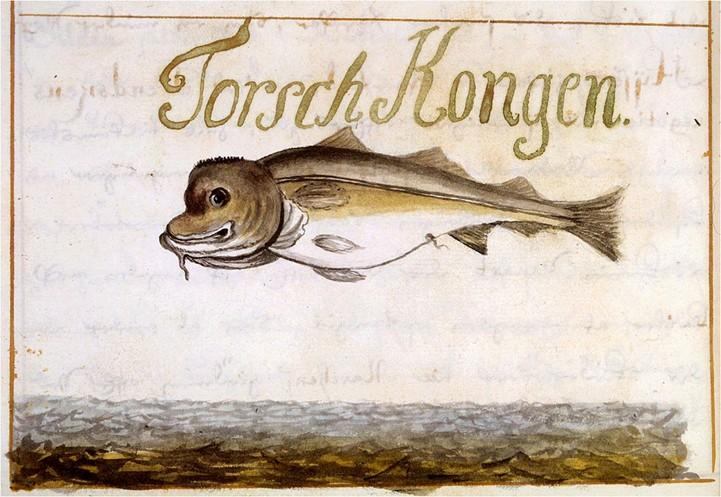
The feature that distinguishes the cod king from ordinary cod is its peculiar head shape—a deformation of the skull that can be interpreted as a sort of crown. It always swims together with normal cod in the large Northeast Atlantic schools. These deformities occur extremely rarely, perhaps in only one out of a million cod, yet every year a few cod kings are still being caught, something that has happened for centuries.
The head shape is so unusual and characteristic that fishermen notice it immediately when the catch is hauled on board. Apart from the deformity, it looks like a normal cod. But according to the myth, it was no ordinary cod with a misshapen head. On the contrary, the cod king possessed special powers, and catching such a fish was considered a positive omen.
The myth held that the cod king led large schools of migrating skrei (cod) to their spawning grounds and brought good fortune to the fisherman who caught it. The school would then gather where the cod king had taken the hook, thus providing the lucky fisherman with abundant catches and prosperity.
If a fisherman managed to catch seven cod kings, he would have good fishing luck for the rest of his life.
What does the researcher say?
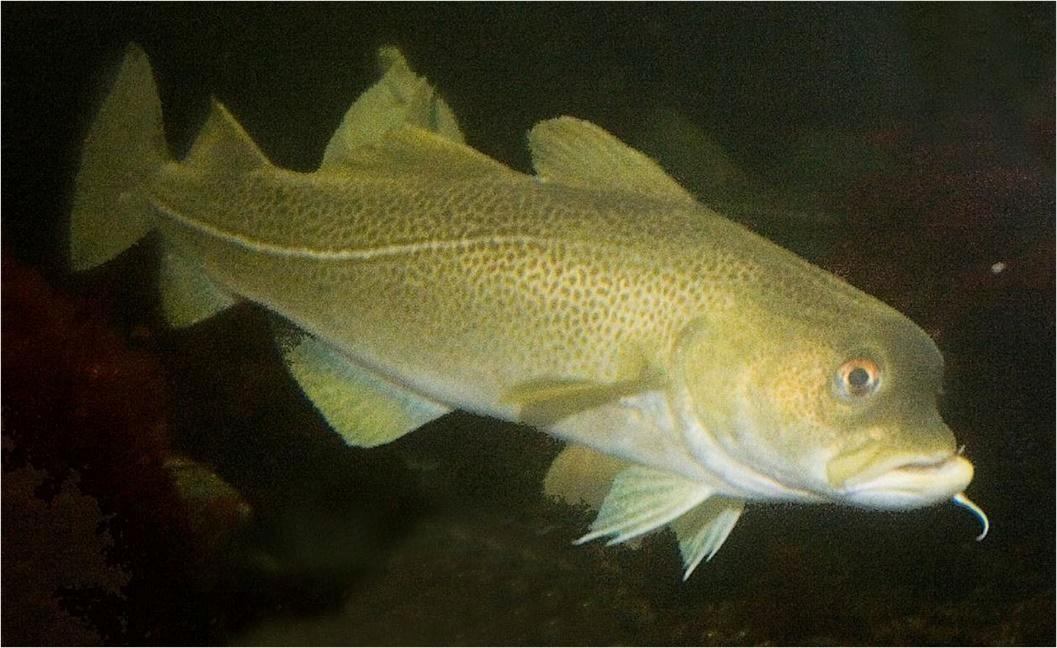
A sober researcher sees things rather differently and describes the "crown" as an undesirable deformity—without a trace of mythical power! Or in his own words:
"A skeletal deformation is an undesirable abnormality both in nature and in cultured environments. In aquaculture, such deformities can cause reduced growth in the stock, lower kilo prices, gives poorer animal welfare, and can damage the company's reputation."
These types of deformities occur less frequently in nature, probably due to stronger competition among individuals. The deformity affects the forehead area so that it becomes shorter than the lower jaw and therefore looks like a crown. Such a deformed fish is for this reason called Kongetorsk in Norway. Jeffries Wyman told Charles Darwin in 1860 about this phenotype in certain cod individuals; he had himself seen such a cod among local fishermen in Labrador. Darwin refers to Wyman's information about the "bulldog cod" in his book The Variation of Animals and Plants under Domestication (Fjelldal, P.G. 2015).
Drying the Cod King – the Good-Luck Bringer
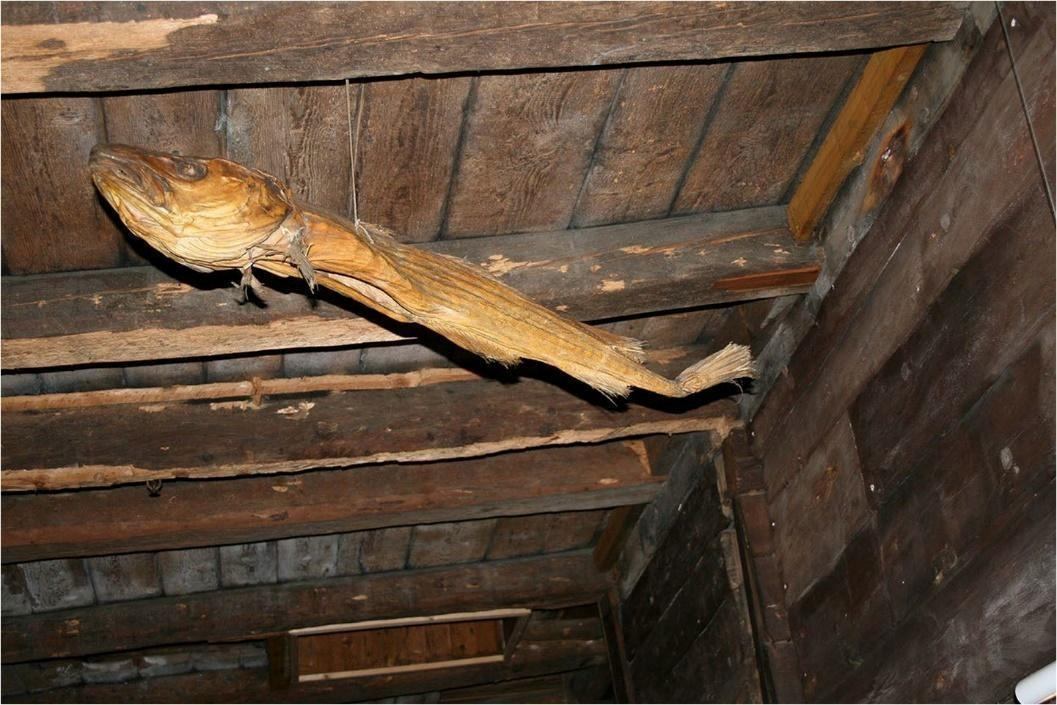
When a cod king was caught in the old days, it kept its head. It was dried head-up and then sent to Bergen, where the merchant who bought it hung it from a woolen string under the office ceiling. It would bring good fortune to its owner and could also predict the weather. In low-pressure conditions, the fish would often turn its head toward the wind direction.
Cod kings are still dried with their heads on and hung in boathouses throughout Lofoten and Northern Norway, though the belief in the old myth is not as strong as before.
The cod king was not the only "king" in the fish kingdom. Many large or unusual fish could also be considered kings if they appeared or were caught together with larger schools of other fish. Fishermen themselves bestowed these royal names, sometimes using the term styrja or størje instead. In the Nordic countries the term størje was often used for certain especially large fish that fishermen believed led or protected schools appearing along the coast.
The Atlantic bluefin tuna (makrellstørje) is a good example of a large "styrja-fish" that, according to tradition, led the mackerel schools during their migrations. The opah (Lampris guttatus) is another fish with "styrja", or king status. It belongs to the ribbonfish group and is considered a good food fish. It is also something of a giant—the largest individuals grow up to two meters long and can, in rare cases, weigh as much as 200 kg. In Norway it is an annual visitor that occasionally ventures as far north as Troms and Finnmark.
The well-known priest and topographical author Peder Claussøn Friis (1545–1614) described the opah from the perspective of his time. For him, there was no doubt that it had very important tasks related to salmon migrations:
"The salmon-størje leads the salmon here to the land in the spring and away again in the autumn and protects them from seals and other fish that would harm them.
The salmon king or størje does not readily enter the fjord but remains outside, and is therefore rarely caught."
The herring king (Regalecus glesne) is an enormous and rare fish also belonging to the ribbonfish group. It has a long, elongated body resembling a giant eel and can grow over eight meters long and weigh up to 270 kilos. In folklore it has sometimes been interpreted as a sea serpent. Right behind its head are 10–15 long fin rays with fleshy lobes at the tips. With some imagination, these fin rays can resemble a crown.
The herring king lives mostly at great depths, up to 1000 meters. But sometimes it rises to the surface and is then often observed near herring schools. Combined with its "royal crown" and impressive size, it is easy to imagine that it was the king of the herring.
In Scandinavia we have several fish kings associated with regional fish stocks. Large ling were called kungsål or ålkung in Sweden. Horse mackerel was called mackerel king in Bohuslän, while the large red gurnard was called knurrkonge in Norway. There are also freshwater "fish kings," and several other varieties of king fish linked to herring and mackerel.
Especially large herring or herring with colored heads were in places in Denmark and Sweden called "herring kings" (sillkung). Such herring king could be a large red-headed herring leading the school.
In Norway, several other fish species have historically had their "kings." These were always particularly large individuals appearing among schools of smaller species. Around the country we find sei kings, haddock kings, and cusk kings. The large conger eels are also called "king eels," likely due to their size compared to other eel species. A fully grown conger eel can reach three meters in length and weigh up to 30 kg.
The king designation is not limited to fish but is also applied to mammals, birds, reptiles, and insects. In a beehive, the queen is the center of life and much larger than the other bees. The golden eagle is considered Norway's most magnificent eagle (although the white-tailed eagle is larger). The mighty male lion is considered the king of animals in many cultures. The "king of the forest" can refer to either the moose or the bear.
A stable mystery, four hundred years on
The cod king has gained its "royal status" thanks to a skull deformity—not because it is otherwise larger or differently built than ordinary cod. When we call this typical "royal crown" a deformity, we acknowledge, as the researcher points out, that it is something negative—a flaw or defect. Most would call it an unfortunate mutation. Yet this mutation is peculiar.
Typical mutations appear suddenly in an individual as a biological anomaly and then disappear if they make the individual (or its offspring) less viable in the struggle for survival. However, if the mutation confers advantages, making the animal better at finding food, for instance—it will eventually spread throughout the species and displace individuals without the advantageous change. This is a classic evolutionary theory. But the cod king's strange skull shape seems neither to make it more nor less viable than "normal" cod.
What is special is that this deformity reappears again and again, unchanged, over many centuries. The first known image of a cod king from the 1600s looks very similar to the cod kings fishermen catch today.
That the "crown" has remained unchanged for so long suggests that the "defect" is a deeper genetic change that has produced a very rare but stable variant of the Northeast Atlantic cod stock—one that is passed genetically from generation to generation. It swims with the large schools and releases its milt carrying this special genetic material at the common spawning grounds. It fertilizes a small number of eggs (or vice versa), enough for the variant to continue into new generations without changing the skull shape. The cod king appears neither to disappear nor increase in number. The genetic change seems highly stable. Otherwise, it is difficult to explain why the deformity has remained unchanged for over 400 years.
That the sober researcher sees "no trace of mythical power in such a flaw" is understandable—mythical forces have no place in modern natural science. That the fisherman, unaffected by scientific reasoning, sees something different in the "flaw" is also understandable. He senses there is something special about this fish that never seems to disappear but appears year after year, as far back as anyone can remember. He can support the notion of the cod king's powers with concrete experience, such as a dried cod king predicting the weather. So why shouldn't it also bring good luck to the fisherman who catches it? He could also refer to various stories from local tradition about fishermen who suddenly received extraordinary luck after hauling in a cod king. But this is an area to which the researcher has no access—and must therefore dismiss as mere superstition.
The idea of the cod king's special role is part of a rich folk tradition in which certain animals—and especially fish—are seen as having a unique and more significant place than others. But the cod king is the only one that gains its royal dignity through a physiological transformation or "flaw." Otherwise, these designations usually go to unusually large animals or fish.
Folklorist Richard Riegler has shown that the idea of certain animals as kings over others is widespread—not only in Northern European folk traditions but around the world. This likely relates to the hierarchical societal structures typical of human communities, which also appear in many animal groups, such as ant colonies or beehives, but also among other animals that live in large groups—wolves, elephants, and lions—all of which have clear social hierarchies with a dominant male ruling over the group.
By naming certain fish "kings," fishermen extended this concept to the fish kingdom. The difference from terrestrial animals is that the fish kings' purpose is not to rule or mate with the females of the group, but to lead and protect the schools. Coastal folk culture has thus historically classified the maritime environment according to the hierarchical patterns known by both human and animal societies.
The cod king is a fine example of such folk classification and celebration of perhaps Norway's most valuable fish.
References
- Bratrein, H.D. Spålunna og verfesk. Litt om folkelig barometer i Nord-Norge, Ottar s. 162, 1986.
- Bratrein, H.D. Spålunna og verfesk. Litt om folkelig barometer i Nord-Norge, Ottar s. 162, 1986.
- Friis, P. Claussøn, Samlede skrifter, s. 117, Kristiania 1883.
- Friis, P. Claussøn, Samlede skrifter, s. 114, Kristiania 1883.
- Svanberg, Ingvar, The brother of the snake and Fish as Kings, Dep. of East European Studies, Uppsala, Sverige, 1999.
Les artikkelen på norsk → Les mer om tørrfisken i kunsten (norsk) →